



About us History, profile and expertise
The TESLA Power Engineering Lab, UFMG, under the name of Industrial Applications Laboratory (LAI), was created in the Department of Electrical Engineering in the first semester of 1999 by Prof. Braz de Jesus Cardoso Filho and the then graduate students Sidelmo Magalhães Silva and Lícia Neto Arruda. The initial objective was the expansion of the activities in the Power Electronics and Electric Drives sector, based on the interaction with the state and national industry. Such interaction was, until then, incipient in the environment of the Department of Electrical Engineering.
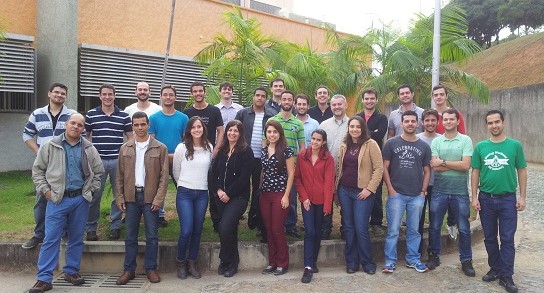
The current coordinating team is the same since the foundation, but the group has grown, expanding its activities, reinforcing its infrastructure and receiving the adhesion of several researchers, technicians and students.
In 2012, the team understood that, with the expansion of its areas of expertise, the laboratory's skills exceeded the scope of industrial applications. The laboratory then became known as TESLA / UFMG - Power Engineering, in reference to the laboratory's vocation for research and technological development in the various areas that involve polyphase electric systems. TESLA / UFMG now has several researchers and equipments to carry out research and extension activities. The collection of equipment is significant, counting on digital oscilloscopes with isolated voltage and current probes, instrumentation for various measurements, digital signal processing systems, microcomputers, low power signal sources low and high power power supplies, drive systems with alternating current motors, programmable multi-phase power supplies, and dedicated systems with hardware and software platforms developed in-house.
Currently researchers and engineers work in areas such as Energy Conservation and Quality, Electromagnetic Compatibility, Power Conversion Design, Special Electric Machines Design, Reliability Engineering and Vehicle Applications, as well as several other areas related to Power Electronics, Energy Systems and Electric Drives.
120
Concluded Projects
60
Active Researchers
85
Defended Theses
147
Scientific Publications